Sunday, January 17, 2010

careen


I'm sure we've all heard, read and probably even occasionally used this one. "The delapidated old truck careened down the highway at breakneck speed," would be an example of the way I'd think of its usage. To my mind, this would be a vehicle that was coming along at a crazy, ill-controlled pace, probably wobbling from side to side as it came.

But early on in my reading of David Mitchell's novel Cloud Atlas, I came upon this sentence: "An Indian war canoe is being careened on the shore." This sentence could mean just about anything, except that careen can not mean what it means in my sentence above. There is another careen of this type in this section of the book, which of course, I can't now find, but somehow between the two of them I've imagined it to mean something like "carved out". However, from just this sentence it could as easily be "decorated" or even "stored".

Mitchell is nothing if not verbally adroit, so this fictional diary excerpt, supposedly written at about the time of the California Gold Rush, I am sure uses careen accurately for that era, and for all I know, this one as well. It would very much surprise me if the two careens were not related. But how did we get from the war canoes to the hurtling truck?


"Careen" means to turn a ship--or in this case, a canoe--on its side, usually to clean, caulk or otherwise repair the hull. The word stems from the Latin carina, which means "hull" both in the nautical sense and in the (probably earlier) sense of a nutshell. In fact once definition I read calls it 'half a nut shell, and that makes for a visual image which at least to me shows the connection between the two meanings pretty clearly.


But "careen" also had another nautical meaning--that of a ship leaning to one side as it sails in a strong wind. It seems pretty clear to me how this second meaning grew out of the first, and our current idea of lurching or swerving from side to side came in turn out of this secondary meaning.

However, a controversy arises! Some etymologists get very frustrated by this use of the word careen when they are sure people are actually mixing it up with "career", which in one of its senses means "to gallop, run or move at full speed". You can read about this argument at what looks like a very good, if opinionated word usage site here.

My own intuition would be that the two words have been to some degree conflated. I base this finding on the highly unscientific evidence that it sounds exactly like something I would do.

Finally, my web wanderings took me to this lovely site, where careen, or at least carina becomes part of the cosmos itself. Reading through the way many things in many languages connect back to one simple word gives me a sense of language as a very far-flung gorgeous net indeed.

Sunday, January 10, 2010

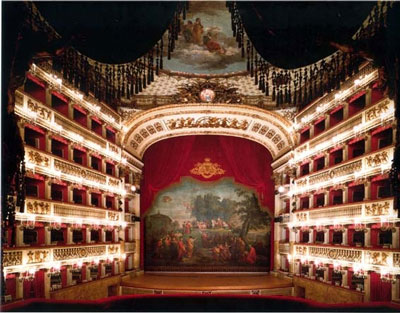
opera


I know--no one is going to believe for a second that I don't know what opera is. No, this is more an "ignorance of origins" kind of post. I came across this little aside in Jacques Barzun's From Dawn to Decadence, correcting my and doubtless many others' assumptions about the word.

"Incidentally, the word opera is not, as one might suppose, the plural of opus, Latin for work. It is another Latin word, opera, plural operae, which means willing work instead of the necessary or forced labor implied by opus. By extension, opera was used by the ancient Romans for any elaborate undertaking, just as we say, "a production". The word certainly fits the reality of staging one of these works as it is described in the history of the great opera houses: a battle with wounded and vanquished before roles and wills are subdued into a temporary unity."

I am an opera fan, though as may easily be suspected, a relatively ignorant one. Barzun surprised me again by saying that it wasn't until the middle of the twentieth century that a divide between music devotees and opera fanatics was healed, the music lovers looking down on the opera types, who often weren't interested in any other sort of music. What brought them together in realizing their common ground? Barzun says it was the advent of the LP, which made it possible to see that the opera without all the hoopla of the production was, in fact, musical. It's always interesting to learn that something we take for granted wasn't at all obvious before some new innovation makes it possible to see or in this case hear things differently.

Saturday, January 2, 2010

vaudeville


Okay, I know what it means. Not that I've ever seen an actual vaudeville show, but it's referred to in countless movies and tributes to the American theatre ad nauseum. I like the song and dance, the jokes seem almost purposely tedious. Ba-da-boom.

So, no, that's not the ignorance I'm talking about in this case. What I'm referring to is a kind of lack of depth of vision, which I would say is a peculiarly American trait. Because, though we reach back to vaudeville, it turns out that vaudeville reaches back a good deal further than that.

Thanks to this interesting post I, am reading (at a very leisurely pace) From Dawn to Decadence: 500 Years of Western Cultures by Jacques Barzun. And learned, in one of his countless throwaways that vaudeville, as "a storytelling song in many stanzas", was invented by the French in the sixteenth century.

A moment's thought would have revealed the word as French, but of course I never did take a moment's thought about it. Until now. Let's take a little closer look and see what can be learned about how a very old French word crossed the Atlantic and made a form of American theatre.

...Well, it's all quite fascinating, really. At least to me. There are actually two possibilities of the word, at least as it's been passed along to us: a corruption of the phrase voix de ville, or 'voice of the city'--which I assume would be referring to the city of France, Paris. The other option is that it is a corruption of Vau de Vire a Normandy valley noted for its distinctive songs. No, make that three--vaux de ville or 'worth of the city' was one other promulgated possibility when it first hit our shores.

Corruption, I think, would be the key here. Because apparently this word came into vogue here in the mid 1800's for two 'uplifting' reasons. First, the Frenchified name was meant to distinguish it from the working class shows billed under the name of 'variety', and second, it was supposed to be a kind entertainment that appealed to that great American ideal, 'self-betterment'.

From the Free Dictionary reference, it seems safe to assume that the actual word made its way into the country via New Orleans, where French was entirely legit, but then became part of a veneer of psuedo-sophistication for parts general.

As one Albert McLean suggests, the name was merely selected "for its vagueness, its faint, but harmless exoticism, and perhaps its connotation of gentility."

Now that's American.

Sunday, December 27, 2009

cant

One of those words I used recently without really knowing what the heck I was saying. Sure, I probably use it more or less accurately in a sentence. "There was the usual cant about tolerance," for instance. I think I could easily substitute "claptrap" for "cant" in any sentence I would use it in, but it probably means something more like a rote answer or the party line. However, perhaps its definition and origins will prove more complicated...

So I'm pretty on the mark with this one. Princeton's wordnetweb has it as "buzzword: stock phrases that have become nonsense through endless repetition". It apparently often shows up in the context of religion or morality, where doubtless there are more platitudes than in many bodies of knowledge. I was interested to find a secondary meaning--well, there are many meanings of cant that have nothing to do with this definition, actually, but not all are to the point here-- that of "slang" or "argot", or specialized language intelligible only to those in a closed society. My particular interest comes from a post on argot and related words that I did some time ago and that I had to look up just to make sure I hadn't already covered this. (It's going to happen sometime here, and when it does, it will be deeply discouraging.) "Cant" should have been included in that post, but was not.

I wondered as I contemplated this word if it was related to "chant", and apparently it is. "Cant" comes from the Anglo-Norman, where it meant "singing" or "song". My guess is that our current usage of "cant" stems from the sing-song nature of droned phrases that no one is really listening to anymore--not even the speakers themselves.

Tuesday, December 15, 2009

boondoggle


One of those words that I felt perfectly sure I knew the meaning of, if somewhat vaguely. However, a line in William Boyd's new novel Ordinary Thunderstorms made me suspect that I'd gotten the thing entirely backwards. Of course, I can't find the line to save my life now, but that's probably just as well, as it might lay my doubts to rest prematurely. It could, after all, have been a mere misreading.

Here's what I thought a boondoggle was--something you get stuck in, like a quagmire, or stuck with, like a piece of real estate in a swamp. But my reading of Boyd's sentence makes me think that a boondoggle is really more of a bonanza, a goldmine. Very far from my interpretation.

I have no idea where this word comes from--it sounds like something that came out of the South, which probably means it didn't. It's a great word, though, and I intend to use it more often. At least, once I know what I'm really saying...

Okay, neither what I thought it meant or what I thought Boyd meant are right, but I am sure Boyd did use it correctly in a sentence. It means "an unnecessary or wasteful project or activity". Coined by a Boy Scout scoutmaster, Robert Link, it refers back to objects made of braided cord or leather, which the scouts wore as kerchief ties, hat bands or other decorations. I am not sure if Link understood the satiric use of the word or not when he coined it. I'm guessing probably not. I don't have the sense that the Scouts were all that big on making fun of themselves.

A nice article from ZDNet actually vindicates me a bit, or at least helps me understand my miscomprehension. It mentions that the word was first used after the big government jobs programs that attempted to remedy aspects of the Great Depression. So there is a sense in it of massive projects, which, of course from some points of view are bound to look like a huge waste of time and money. We may have some boondoggles of our own in the near future, come to think of it.

The ZDNet article says that a distinguishing feature of a boondoggle is that at some point there is a realization that the project is not ever going to work, but that the project continues forward for a long time, despite this realization on the part of some. That site has a link to this article which lays out the etymology very well.

But to summarize. Sometimes, a boondoggle is only a lanyard. And sometimes, a boondoggle is a massive, incompetent endeavor by the State, the Military, or Big Business that is a huge waste of time and funds, benefiting no one.

Personally, I'll take the lanyard.

Tuesday, December 8, 2009

Treasure!

Until recently, I thought that 'treasure' was a somewhat antiquated word. Buried treasure, treasure chest--still not out of our common usage, but not what we'd refer to in everyday speech. We don't say, "I think I'll go check how much treasure I have in my checking account", for instance. Though we might still say, somewhat sentimentally, 'I treasure the moments I had with her.' But this kind of sentence still puts the actual word 'treasure' at one remove.

A few days ago though, I heard the word used in earnest. As new U.S. troops are mobilized for Afghanistan, I heard a couple of very serious types on the news shows evaluating the decision in terms of its cost in 'Lives and Treasure'.

So what is treasure, exactly? We all know what it means to us, of course. It's not an obscure word. But what does it mean to these experts who use the phrase 'lives and treasure' so gravely and so authoritatively?


Well, the first thing I learned may be obvious to those who still remember some of their Attic Greek, but I was surprised to learn that 'treasure' actually stems from the Greek word 'thesaurus', which originally meant both treasure and the place to store it. Our modern day 'thesaurus' seems to mean some sort of treasury, and it's interesting how often books of collected stories or poems have referred to themselves as treasuries, as if the idea of collecting samples of the printed word led fairly quickly to the idea of a book as a sort of storehouse of texts.

However, though I expected some sort of precise legal definition of 'lives and treasure' to float to the surface during my research, in fact, it seems to be very much one of those phrases that someone used and which then got picked up by others because it sounded solemn enough. For some reason, American talking heads seem to have been very fond of using it in relation to the wars in Iraq and Afghanistan. 'Blood and treasure' is an alternative form of the phrase.

I thought it would be interesting to see how far back the expression actually goes. Nothing conclusive came up, but I did like this site's imaginative and possibly even true linking back to a time just a bit further away from us than Gulf War I.

Wednesday, December 2, 2009

turpitude

I first learned about the right of U.S. Customs to ban people from entering the country based on their moral turpitude awhile ago, after the strange case of Sebastian Horsley, who was detained and then sent home on these grounds, partly perhaps based on his tell-all memoir Dandy in the Underworld.

This seemed extreme, but the doings of a Horsley seem a bit remote from my daily life, and so I put this in the 'noted with interest' mental file. However, last night at a dinner party, I learned that a friend of a friend has also just been banned from the U.S.--for life--for being a bit too candid on the custom forms about some past indiscretions. As I happen to know a little about the nature of these 'crimes' and also know from personal experience what a kind and decent human being he actually is, I find this all more than a tad beyond the pale.

Be that as it may, the real question that came up for us was, what is moral turpitude. And for me, more specifically, where does the word 'turpitude' come from?

One of my friends was not even sure if moral turpitude was a good thing or a bad thing. He's well-read, it's just that it doesn't come up all that much in daily life. While not knowing its roots, I do know that turpitude is bad, and I'd sort of roughly take it as the opposite of moral rectitude. I don't know if the word is related to words like disturb, or turbulent, because I also have this idea that it relates to darkness.

Okay, enough guessing.

Right idea, wrong root. Turpitude comes through Middle English from French and further back from Latin. Turpitudo means 'ugliness', and its root is turpis, or base. So it would seem that this word, despite geographic migrations hasn't strayed far from its, ahem, base, at least in terms of meaning.

The alphadictionary folks make a good point though in saying that the term 'moral turpitude' is a bit redundant, as there really aren't any other forms of turpitude that aren't related to morality. They have, for instance, ruled out the possibility that the word is related to 'turpentine'. No, it's just general baseness all the way around.

As for what moral turpitude meant in the Horsley case, Slate Magazine dissects it for you here.

Meanwhile, my friend is inclined to take his 'banned for life' status here with a "que sera, sera" attitude. Luckily, the sponsors for his American trip were able to find a substitute destination for him.

He was sent to Rome, where the question of moral turpitude apparently bothers no one at all.